Image
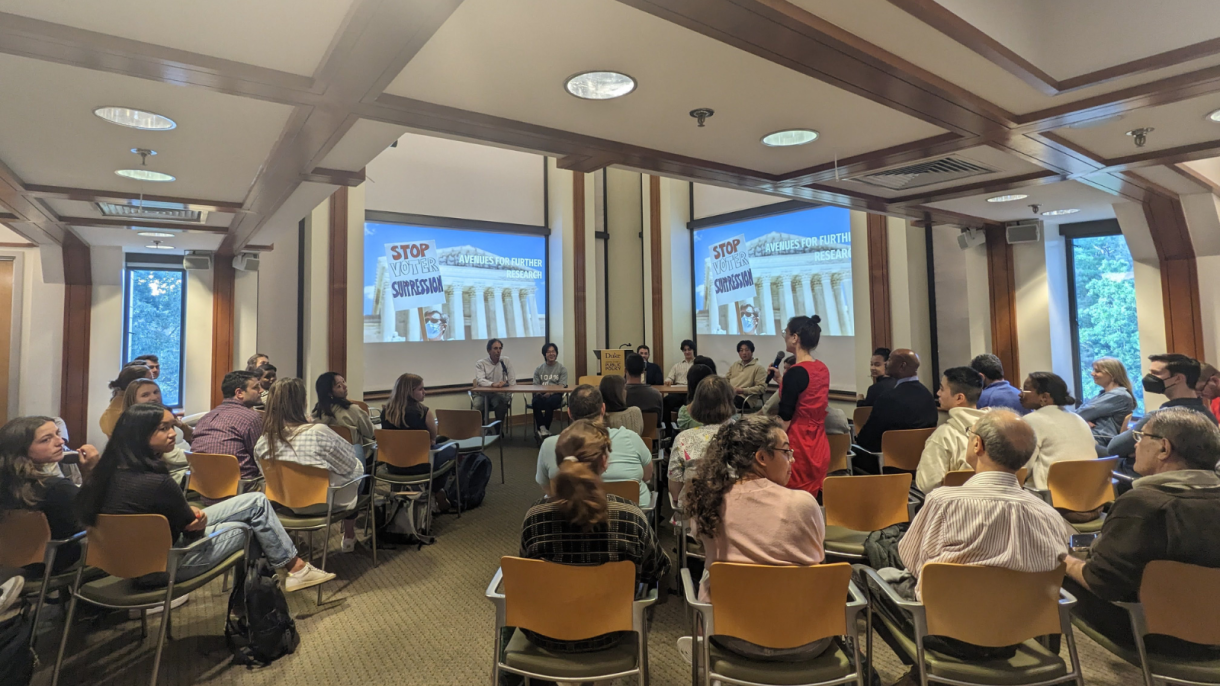
During the 2022-2023 academic year, three pop-up teams addressed issues related to democracy and the challenges of sustaining strong democratic institutions in a polarized world. Teams explored the voting system in the United States; the social, political and health impacts of political polarization in church clergy and congregations; and how to combat information gaps and the erosion of public participation in democratic processes.
The teams presented their work at the virtual 2023 Bass Connections Showcase alongside 56 other project teams.

Team leaders: Sanford School of Public Policy (Kristin Goss, Asher Hildebrand, Deondra Rose, David Schanzer)
Student participation: 11 undergraduate students, 3 graduate students
Free and fair elections are the fundamental building block of democracy. In the U.S.’s federal system, the 50 states have widely different procedures for managing all aspects of the voting system. These divergent practices have long been a matter of controversy, and disputes over the integrity of the 2020 presidential election only exacerbated such concerns.
This project team aimed to create a quantitative method for evaluating inequality in democracy across states. They analyzed disparities in voter turnout during the 2020 election for four demographic categories — race, disability status, age and educational attainment — and compared the election policies of states with the disparities between advantaged and disadvantaged groups in these categories. The team then modeled a series of logistic regressions using weighted survey data across six election cycles (2010-2020).
Team leaders: Duke Global Health Institute (David Eagle), Arts & Sciences: Political Science (Christopher Johnston), Arts & Sciences: Sociology (Erin Johnston)
Student participation: 9 undergraduate students, 4 graduate students
Polarization within churches along political lines has risen in recent decades. Most existing research on the role of religious organizations in politics, however, focuses on either conservative or liberal Protestants. Less attention is given to Mainline congregations and clergy.
This project team explored the social, political and health impacts of political polarization in Mainline clergy and congregations to develop recommendations to clergy for how to facilitate civil discourse and bridge political difference. Team members divided into subteams, each of which used a different data source to examine how clergy think about the relationship between politics and religion, the extent to which clergy discuss salient political and social issues from the pulpit, and the impact polarization and political conflict are having on clergy well-being.
Team leaders: Sanford School of Public Policy (Stephen Buckley, Philip Napoli, Asa Royal, Andrew Trexler (Ph.D. student))
Student participation: 8 undergraduate students, 3 graduate students
Research in political science, psychology and economics has extensively documented the routine failures of ordinary citizens to fulfill the duties expected of them under democratic theory. These failures arise from the tension that voters face when participating in the democratic process: a desire to make the best decision and a desire to make an easy decision. Technological changes have made it easier for disinformation to flourish and have made identifying accurate and reliable news and information sources more challenging.
This project team explored remedies to the growing information gaps that threaten democracy. The team found that disparities in information and trust were not addressed by subsidizing access to local news, that people were interested in reading news that directly affected them but were likely to abandon news sources that practiced sensationalism and racially biased coverage and that legislation regarding media literacy is unequal and inconsistent across the country.
Several team members presented at the Local Journalism Researchers Workshop co-hosted by the UNC Center for Innovation & Sustainability in Local Media and the DeWitt Wallace Center for Media & Democracy.