Image

In this profile, Bass Connections student research awardee Matlhabeli Molaoli (Ph.D. in Cultural Anthropology ’30) reflects on her work in Maseru, Lesotho, examining the lived experience of chronic unemployment among university-educated women. Building on the 2024-2025 What Is Hope? Bridging the Gap Between Lived Experience and Research project team project team, Molaoli's work explores how women navigate uncertain labor markets, how government and community responses shape everyday life, and what hope means when higher education no longer guarantees economic opportunity.
Molaoli’s project was one of 14 student-directed, faculty-mentored research projects funded by Bass Connections in 2025-2026. Read more about these projects and propose your own project for next year.
“This event felt like history was unfolding right in front of us. I was glad to witness it because it afforded me insight into the discourse around job creation in Lesotho: despite being a long-term problem, unemployment was now given a sense of urgency, or even desperation.”
By: Matlhabeli Molaoli
This profile has been lightly edited for length and clarity.
In the summer of 2025, I set out to study unemployment in Lesotho, where, by some measures, 40% of youth cannot find work. As an anthropologist, I am invested in the social and cultural aspects of unemployment. What is unemployment as a social category? What does it mean to be out of work as a member of a community, as an adult, as a man or woman? Using ethnographic tools — interviews, archives and participant observation — I aimed to study the everyday reality of unemployment, to make sense of a macro phenomenon through the eyes of those living (through) it. I especially wanted to understand this widespread situation from the perspective of university-educated women, many of whom grew up believing that education is the key to success. What is the nature of their hope if higher education now fails to deliver on promises of upward mobility?
I spent four months living in Maseru, Lesotho, conducting interviews with unemployed women. These included a nail technician in her mid-twenties, a woman who had just finished a short-term contract administering surveys with the World Food Program and a social sciences Ph.D. graduate. I also spoke with two people who ghostwrite resumes, cover letters and help with interview prep. I attended workshops on personal branding for women and a pitiki — a women-only celebration with speeches, music, dancing and drinking. I witnessed hundreds of people camping overnight to apply for a handful of positions in the military, braving the winter cold to keep their place in lines that snaked around buildings and into main roads.
One of the most important events I attended was a youth engagement event hosted by the Office of the Prime Minister with the theme “collective contributions to curb unemployment.” By 10 a.m. the Manthabiseng Convention Center, one of the largest venues in the country, was packed to the brim. I squeezed into a nook along one wall of the auditorium, standing with others who could not find chairs, all eyes fixed on the stage. The air was expectant. When he spoke, Prime Minister Matekane formally declared unemployment a state of emergency and directed the Disaster Management Authority to treat it as such. The room went wild! Deafening cheers and ululations followed, then a song ruptured from the crowd:
Matekane ke lesole la masole! (Matekane is a soldier among soldiers!)
Ha a li etsa oa li emela! (When he does something, he stands his ground!)
Matekane promised that his government would create a whopping 70,000 jobs by the end of the month. They would make it easier for young people to create employment for themselves by scrapping business registration fees, for example. For the rest of the day, cabinet ministers and corporate leaders took turns announcing ongoing and future initiatives that would employ young people.
This event felt like history was unfolding right in front of us. I was glad to witness it because it afforded me insight into the discourse around job creation in Lesotho: despite being a long-term problem, unemployment was now given a sense of urgency, or even desperation. The Prime Minister’s address helped me realize that the “unemployment industry” — all the people ostensibly working to solve unemployment — were experiencing this feeling of crisis, too. It was not just the unemployed. I was especially struck by the symmetry between the government’s declaration and the youth protest that had shaken Maseru five years earlier.
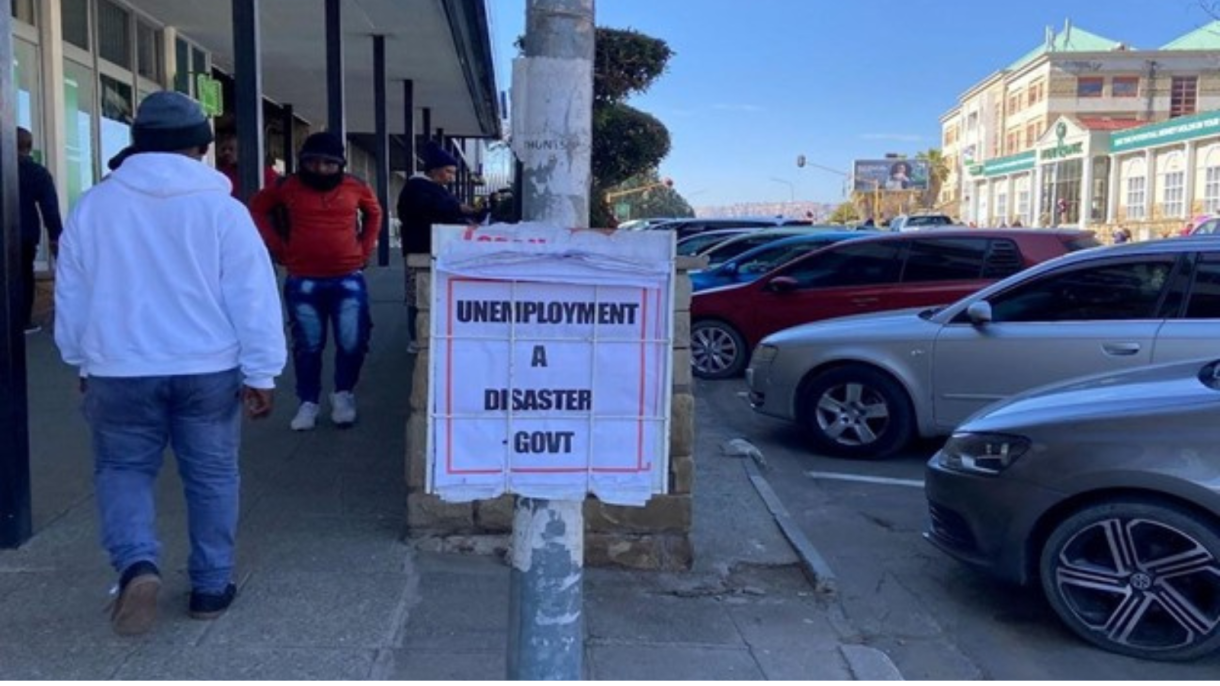
In 2020, young people marched on parliament (and were met with force and tear gas) to demand that the government declare unemployment a state of emergency, like it had the COVID-19 pandemic. Here was the same language, now adopted into official government discourse (even though actual policy direction has been sparse, almost a year later).
This preliminary fieldwork helped me generate new questions to take into my research for my dissertation. It provoked me to consider what kinds of feedback mechanisms the unemployment industry has developed with the unemployed, and vice versa. The Prime Minister’s declaration suggests that the two are not disparate and that they relate in meaningful ways. Perhaps the unemployed and the people working to reduce unemployment are two sides of the same coin. One of my main tasks with long-term fieldwork is to observe and describe that coin.
May 2026