Image

The “In Their Own Words” series features profiles written by members of our 2024-2025 Bass Connections teams that showcase the discoveries, challenges and impact of teams who spent the year tackling real-world problems.
Platform accountability, or the evaluation of how a technology platform (e.g., Etsy, Roblox, Spotify, YouTube) demonstrates secure data management processes, is important to how we assess the impact of a platform on security and society. Legislation and policy must be carefully constructed to monitor and regulate responsible industry behavior. However, experts are divided on the best approach.
The Platform Accountability in Technology Policy team developed a platform accountability framework for how companies can demonstrate that they are behaving responsibly and for governments to measure their behavior more effectively. Team members examined the intersections between business, law and policy to understand platform accountability and the processes for evaluating companies’ compliance to standards.
This team was led by David Hoffman (Public Policy) and Kenneth Rogerson (Public Policy).
By: Members of the Platform Accountability in Technology Policy team
Our team examined the responsibilities of platforms like Etsy, Roblox and Spotify around key themes, such as transparency around compensation and pricing models; use of data profiling for targeted advertisements; disclosure of AI-generated content; flagging mechanisms for harmful or inappropriate content and copyright.
In the fall, team members wrote in-depth analytical reports on Etsy, Roblox, Spotify and YouTube with explorations of their privacy policies, terms of use policies and applicable regulations.
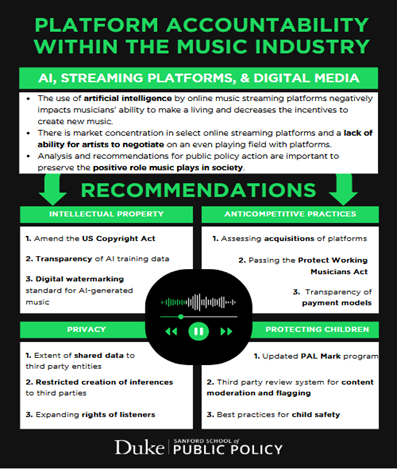
In the spring, the team wrote a white paper examining the impact of AI on the music industry, focusing on policy solutions around intellectual property, anti-competitive practices, privacy and personal data use and protection of children. The team presented research to music industry and advocacy stakeholders in Washington, D.C., in April 2025. Team members also used the content of the white paper to produce additional policy deliverables, including one-pagers, infographics and blog posts.

Our findings on AI in the music industry are summarized below. These findings will serve as a foundation for our 2025-2026 team.
AI in the Music Industry Technology has brought new methods to create music and reach listeners. However, it has also decreased the ability for musicians to receive just compensation for their creative work.
AI use by online music streaming platforms has the potential to amplify this negative impact on human artists. In some cases, AI is replacing human musicians as algorithms create new music from databases of existing human work.
Music has played an important role in democratic participation and free expression. Analysis and recommendations for public policy action are important to preserve the positive role music plays in society.
Recommendations
Recommendation
Recommendation
Recommendations